


Back
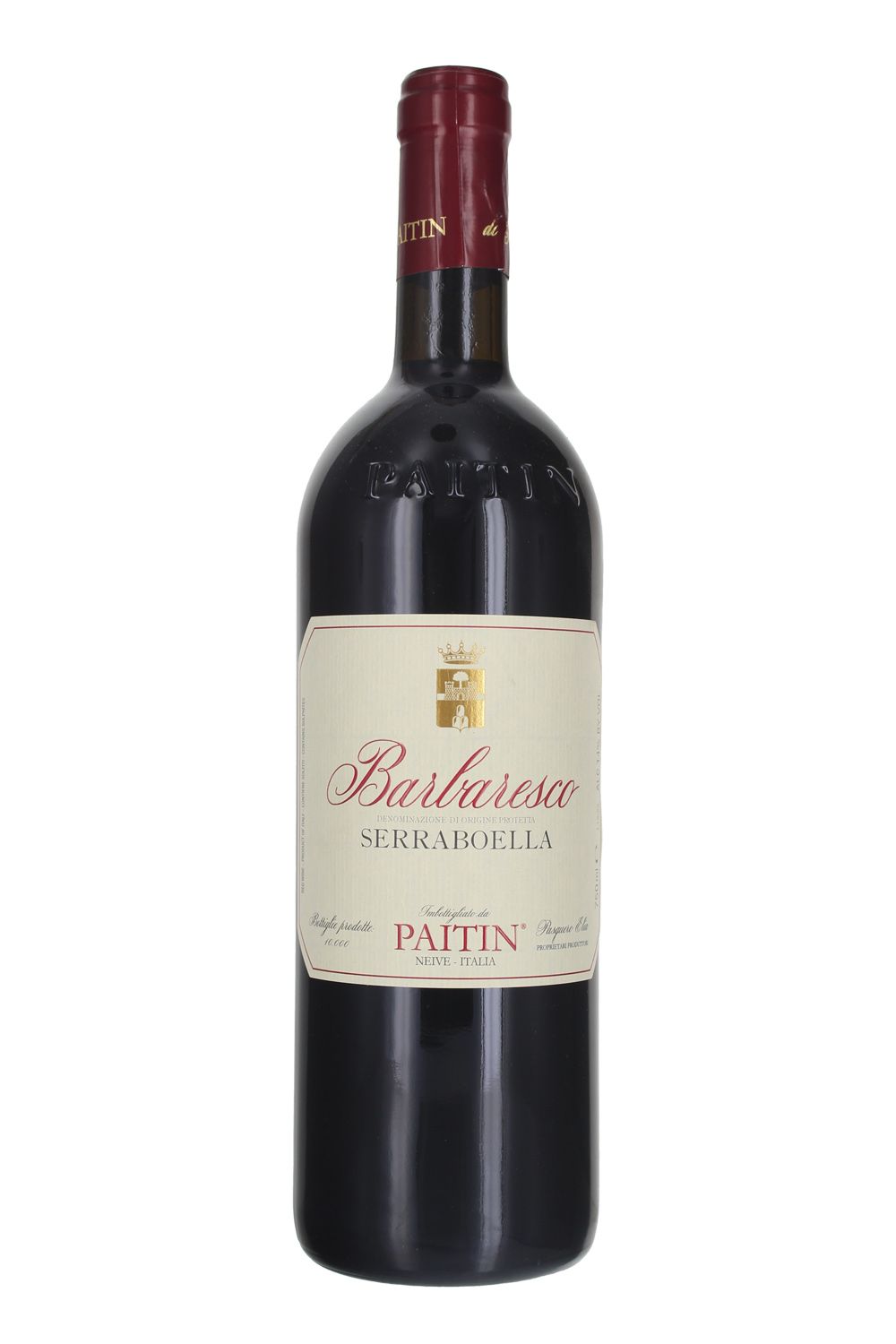
2022 Barbaresco Serraboella, Paitin
 Add to Wishlist
Under the stewardship of Luca Pasquero-Elia, Paitin have quickly become one of the most exciting estates in Barbaresco. Serraboella is the most famous cru in the Southern Neive. A long hill exposed to West that gently bends towards South ge tting steeper.
£59.00 1 x Bottle (75 cl)
Tasting notes
Serraboella is the most famous cru in the Southern Neive. A long hill exposed to West that gently bends towards South getting steeper. A pretty style of Barbaresco with supple tannins and layers of spice, rose and cherry fruit. Finally some shy savoury tobacco notes come through to linger on the long finish.
At a glance
producer
sub-region
region
country
grape variety
vintage
colour
abv
maturity
organic status

Reviews
The 2022 Barbaresco Serraboella is another success for Paitin in this vintage. A wine of reserved power, the 2022 needs a few years to come together, but it has considerable potential. Dark red fruit, iron, new leather, incense and blood or ange infuse the 2022 with tons of character. Give the bruising tannins a few years to soften. This understated Barbaresco packs quite the punch. An iron fist in a velvet glove.
Antonio Galloni
The 2022 Barbaresco Serraboella is one of the most reticent wines in this range. Searing tannins are very hard to get past at this early stage. Deeply pitched spice and earthy notes struggle to emerge. The 2021 is a tannic behemoth, showing very raw, intense tannins. This is hard to taste today.
Antonio Galloni
Piedmont
This is possibly the most stunningly beautiful wine region in Europe and certainly one of the best to visit and although it was at the forefront of the Italian industrial revolution and the main driver towards unification, in many ways Piedmont (Piemonte in Italian) feels less ‘Italian’ than many regions further south. Formerly part of the Francophone Kingdom of Savoy, neighbour to the Duchy of Burgundy, comparisons are regularly made with Burgundy and they are not without merit. Both regions produce superlative, age worthy and unique red wines from single varieties and from highly defined vineyards, both have a strong food culture and in both regions the owner of a property is very likely to be seen working in the vineyards themselves, rather than in a suit in a boardroom. ‘International’ varieties, whilst present, have never really caught on here as Piedmont has its own world class varieties and in Nebbiolo, one of the greatest varieties of all. The region was almost exclusively a red wine area, with the exception of the Moscatos from Asti, until the late 20th century, when Gavi became a more significant player and Arneis and Favorita began to be planted in more commercial quantities. Although white grape plantings are growing, it is still the reds that are by far the more important. Piedmont is the only Italian region without IGTs, a misguided attempt to portray all of its wine as of higher quality. The catch all Piemonte DOC is therefore of limited value as a guarantor of style or quality, with the (relatively) smaller DOCs of Langhe and Monferrato are only a little more useful. Of the 45 DOCs and 17 DOCGs, Barolo DOCG and Barbaresco DOCG are by far the most important. There are now over 1,900 hectares of vineyards given over to Barolo (a 50% increase on the area in 1990), with the quality outside of the generic supermarket bottlings being very high. All Barolo shares powerful tannins, a dense texture, high acidity and high alcohol. Despite Nebbiolo being a very dark skinned variety, the wines are never deep in colour and tend to show aged signs of garnet very early in life, although in recent years this has become less apparent. The wines show complex aromas of rose petal, tar, liquorice, cherry, plum and hints of truffle. There are great variations across the zone and even from vineyard to vineyard, as soils vary enormously, as does the topography. The greater region can be separated in two: with Verduno to the east, Barolo and La Morra, featuring the finest Crus of Cerequio, Cannubi, Sarmazza and Brunate. Then to the east, with Monforte and Serralunga, whose finest Crus are Bussia , Castelleto, Ornato and Falletto. There are, of course, many other exceptional Crus throughout the region, with many producers making outstanding wines from tiny plots. Less than half of the area of neighbouring Barolo, with around 700 hectares of Nebbiolo, Barbaresco as a rule is a bit less powerful and structured and was historically seen as a lesser wine for it. Barbaresco certainly lacks the sheer power of the greatest Barolos, but in a world lacking patience, this is not necessarily a bad thing, as the wines have the haunting perfumes of Nebbiolo, fine acidity and tannins that are that bit softer and more approachable. They are certainly no less complex or fine than Barolo, but are released at a younger age and reach maturity sooner, with most at their best between 5 and 10 years of age. Most of the DOCG is situated at a slightly lower altitude than Barolo, is closer to the warming influence of the Tannaro river and is on soils similar to La Morra although slightly sandier, so harvest here is up to 2 weeks earlier than Barolo and the resultant wines less dense. Notable Vineyard Names include; Albesani, Asili, Bricco de Nieve, Curra, Gallina, Montefico, Montestefano, Pajorè, Rombone, Roncaglie (Sori Tildin), and Secondine (Sori San Lorenzo).
![2011 Barbaresco, Crichet Paje, Roagna (75 cl) - Bottle [119510520110100750]](https://du5d0xxkq463h.cloudfront.net/media/catalog/product/placeholder/default/In_bond.jpeg)
![2025 Dolcetto d'Alba, Diego Conterno (75 cl) - Bottle [223409820250600750]](https://du5d0xxkq463h.cloudfront.net/media/catalog/product/cache/e748d881e54f2c9368fad2d1a1421cc2/2/2/2234098.jpg)
![2024 Langhe Nascetta, Diego Conterno (75 cl) - Bottle [144009020240600750]](https://du5d0xxkq463h.cloudfront.net/media/catalog/product/cache/e748d881e54f2c9368fad2d1a1421cc2/1/4/14400902021.jpg)
![2021 Barolo, Diego Conterno (75 cl) - Bottle [144007420210600750]](https://du5d0xxkq463h.cloudfront.net/media/catalog/product/cache/e748d881e54f2c9368fad2d1a1421cc2/1/4/1440074new.jpg)
![2023 Ferrione Barbera d'Alba, Diego Conterno (75 cl) - Bottle [223422920230600750]](https://du5d0xxkq463h.cloudfront.net/media/catalog/product/cache/e748d881e54f2c9368fad2d1a1421cc2/2/2/2234229.jpg)
![2021 Bussia Langhe Chardonnay, La Bioca (75 cl) - Bottle [158131920210600750]](https://du5d0xxkq463h.cloudfront.net/media/catalog/product/cache/e748d881e54f2c9368fad2d1a1421cc2/1/5/1581319new.jpg)
![2022 Langhe Rossese Bianco, Amalia Cascina (75 cl) - Bottle [143270920220600750]](https://du5d0xxkq463h.cloudfront.net/media/catalog/product/cache/e748d881e54f2c9368fad2d1a1421cc2/1/4/1432709.jpg)